
Jodhpur
See what's happening
Browse topics · 47
Jodhpur
Basic informationOpen ↗
| Field | Details | |---|---| | Official Name | Jodhpur | | Common Name | Jodhpur | | Native Name(s) | जोधपुर | | Nicknames | Blue City, Sun City, Gateway to Thar | | Motto | _Data not readily available for this location._ | | Geographic Level | City and District | | Country | India | | State/Province | Rajasthan | | Capital | Jodhpur (District Headquarters) | | Government Type | Municipal Corporation (Nagar Nigam) & District Administration | | Date Founded | 1459 CE | | Time Zone | Indian Standard Time (UTC+05:30) | | Latitude | 26.28° N | | Longitude | 73.02° E | | Elevation | ~231 m (758 ft) | | Total Area | ~22,850 sq km (Historical District Area) | | Population | ~1,033,918 (City, 2011 Census); ~3,687,165 (District, 2011 Census) | | Population Density | ~161 persons/sq km (District) | | ZIP/Postal Codes | 342001 - 342015 | | Area Codes | +91 291 | | Official Languages | Hindi (Official), Marwari (Spoken) | | Currency | Indian Rupee (INR) | | Demonym | Jodhpuri |
OverviewOpen ↗
Jodhpur is the second-largest city in the Indian state of Rajasthan and the historic capital of the Kingdom of Marwar. Widely recognized as the "Blue City" due to the sea of indigo-painted houses clustered around its historic center, Jodhpur offers a stunning visual contrast against the arid backdrop of the Thar Desert. It is also affectionately known as the "Sun City" for the bright, sunny weather it enjoys almost every day of the year.
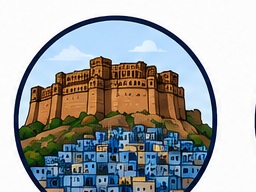
The city anchors a sprawling district that blends ancient regal history with rapidly advancing modern infrastructure. Looming over the skyline is Mehrangarh Fort, one of the largest and most magnificent forts in India, which serves as a testament to the region's rich architectural and martial heritage. Below the fort, a maze of winding medieval streets opens into vibrant bazaars selling everything from intricate handicrafts to renowned local textiles.
Beyond its historical and touristic appeal, Jodhpur has evolved into an educational and industrial powerhouse in western India. It holds the unique distinction of hosting several of India's premier institutes—including an IIT, an AIIMS, and a National Law University—making it a prominent hub for higher learning. From its booming handicraft export market to its emergence as a solar energy frontier, Jodhpur seamlessly weaves its royal past into a dynamic present.
HistoryOpen ↗
Jodhpur was founded in 1459 by Rao Jodha, a Rajput chieftain of the Rathore clan. Before its establishment, the nearby town of Mandore served as the capital of the Marwar state. Recognizing the need for a more secure location, Rao Jodha shifted his capital to a rocky ridge to the south, where he began the construction of the formidable Mehrangarh Fort. The city grew around this imposing citadel, protected by a wall with multiple grand gates.
For centuries, the Kingdom of Marwar was a dominant force in Rajputana. Its strategic location on the overland trade route between Delhi and Gujarat enriched the kingdom through tariffs on opium, copper, silk, sandals, date palms, and coffee. The Rathore rulers alternately fought and formed alliances with the Mughal Empire, deeply influencing the region's art, architecture, and culture.
In 1818, Marwar entered into a subsidiary alliance with the British East India Company, maintaining internal autonomy while acknowledging British paramountcy. The late 19th and early 20th centuries saw modernization efforts, particularly under Maharaja Umaid Singh, who commissioned the iconic Umaid Bhawan Palace, a massive art deco structure built partly to provide drought relief employment to the populace.
Following India's independence in 1947, the princely state of Jodhpur integrated into the newly formed Union of India, officially merging into the state of Rajasthan in 1949. Today, Jodhpur blends its rich aristocratic legacy with democratic governance, remaining a vital cultural and economic center in the region.
GeographyOpen ↗
Jodhpur is situated in the western part of Rajasthan, resting precisely on the eastern edge of the Thar Desert. The district is bounded by Bikaner and Jaisalmer to the north and northwest, Barmer to the west, Pali to the south, and Nagaur to the east.
The physical geography is predominantly characterized by an arid landscape, sparse vegetation, and sandy terrain that gradually transitions into the deep desert moving west. The Luni River, an ephemeral river that only flows during the monsoon season, is the most significant watercourse in the region and provides critical moisture to the otherwise parched land. Natural resources in the region include abundant sandstone, limestone, and vast expanses of open land that receive high solar irradiation.
TopographyOpen ↗
The topography of Jodhpur is largely characterized by a flat, sandy plain with occasional rocky outcrops and scattered hillocks. The city's elevation sits at approximately 231 meters (758 feet) above sea level.
The most prominent topographic feature in the city is the steep, rocky ridge composed of volcanic rhyolite (known locally as the Malani Igneous Suite) upon which Mehrangarh Fort is built. This dramatic escarpment rises about 120 meters (400 feet) above the surrounding plains. Outside the urban center, the terrain softens into rolling sand dunes to the west and northwest, while the eastern and southern edges of the district present a slightly more rugged landscape with low-lying Aravalli outliers.
Weather & climateOpen ↗
Jodhpur experiences a hot semi-arid climate (Köppen climate classification *BSh*), bordering on an arid climate (*BWh*). The weather is marked by extreme temperature variations, with long, searing summers and short, pleasant winters.
* Summer (April to June): Temperatures frequently soar between 35°C and 45°C (95°F–113°F), with dry, hot winds (Loo) sweeping the region. * Monsoon (July to September): The region receives low to moderate rainfall, averaging around 360 mm (14 inches) annually. The rain brings a brief green cover to the desert landscape. * Winter (November to February): Winters are mild, sunny, and highly pleasant, with daytime temperatures around 20°C to 25°C (68°F–77°F) and cool nights that can drop to 9°C (48°F).
The best time to visit Jodhpur is during the winter months, from October to March, when the weather is ideal for sightseeing. Natural hazards primarily include severe droughts due to delayed or failed monsoons, and occasional sandstorms in the summer.
PopulationOpen ↗
According to the last official census in 2011, Jodhpur City had a population of just over 1 million, while the larger Jodhpur District housed approximately 3.68 million residents. The population has grown steadily over the last decade, reflecting regional urbanization trends.
Hinduism is the dominant religion, followed by a significant Muslim minority and smaller communities of Jains, Sikhs, and Christians. The ethnic composition is largely Rajasthani, featuring various distinct communities including Rajputs, Bishnois, Marwaris, and Meghwals.
Hindi and Marwari are the primary languages of communication, though English is widely understood in business, educational, and tourist sectors. Jodhpur boasts a growing literacy rate, which stood at around 80% for the urban population in 2011, reflecting the city's recent transformation into an educational center.
GovernmentOpen ↗
Jodhpur is administered at the district level by a District Collector (District Magistrate), who oversees general administration, revenue collection, and law and order. For urban governance, the city is managed by the Jodhpur Municipal Corporation (Nagar Nigam), which was bifurcated in 2020 into two entities—Jodhpur North and Jodhpur South—to improve administrative efficiency and service delivery. Each corporation is headed by a Mayor.
Politically, the Jodhpur district is a crucial constituency in Rajasthan. It is represented in the Lok Sabha (the lower house of India's Parliament) by a single Member of Parliament (MP). The district is further divided into multiple Vidhan Sabha (State Legislative Assembly) constituencies, electing Members of the Legislative Assembly (MLAs) to the state government in Jaipur. Law enforcement is managed by the Jodhpur Police Commissionerate, overseen by a Commissioner of Police.
EconomyOpen ↗
Jodhpur’s economy is diverse, blending traditional trades with modern industries. It is one of the most prominent industrial centers in western Rajasthan. While exact city-level GDP figures are not readily available, Jodhpur is a vital contributor to Rajasthan's overall economic output.
The local economy has historically relied on agriculture, mining, and trade. In recent decades, tourism has become a major economic engine, attracting hundreds of thousands of domestic and international visitors annually to its forts, palaces, and desert camps. The city is also globally famous for its handicraft and furniture export industry, which ships wooden, metal, and textile goods worldwide.
The cost of living in Jodhpur is relatively affordable compared to Indian megacities like Mumbai or Delhi. The area is also seeing massive investments in renewable energy, particularly solar power, capitalizing on the region's high solar radiation.
IndustriesOpen ↗
* Handicrafts & Furniture: A multi-million dollar export industry specializing in antique reproductions, wooden furniture, and metalwork. * Tourism & Hospitality: Driven by heritage hotels, historical monuments, and desert safaris, this sector supports thousands of local jobs. * Mining & Quarrying: The region is famous for "Jodhpur sandstone," a popular building material used globally, as well as limestone and marble. * Textiles: Known for traditional dyeing techniques like *Bandhani* (tie-dye) and block printing, supporting both domestic retail and export markets. * Renewable Energy: A rapidly growing sector, with Jodhpur district acting as a major hub for large-scale solar parks. * Agriculture Processing: Processing of local arid-zone crops like guar (for guar gum, used internationally in the oil and food industries).
AgricultureOpen ↗
Despite its arid climate, agriculture remains a critical livelihood for the rural population surrounding Jodhpur. Farming in the region relies heavily on the brief monsoon season and canal irrigation.
Major crops include drought-resistant staples like *bajra* (pearl millet), *jowar* (sorghum), and pulses like *moth* bean and *moong* bean. The region is famously known for its Mathania red chilies, prized for their vibrant color and flavor. Cash crops include *guar* (cluster bean), mustard, and cumin.
Livestock rearing is equally vital, particularly the breeding of cattle, sheep, goats, and camels. The region is home to the famous Marwari breed of horses, known for their inward-turning ear tips and hardiness. The Central Arid Zone Research Institute (CAZRI), based in Jodhpur, plays a major role in developing sustainable agricultural practices for the desert ecosystem.
HousingOpen ↗
The housing landscape in Jodhpur offers a sharp contrast between the old and the new. In the historic walled city, housing consists of tightly packed traditional *havelis* (courtyard homes), many painted in the iconic indigo blue. These areas feature narrow, winding alleys and high-density living.
Outside the old city walls, Jodhpur has expanded rapidly. Planned neighborhoods feature spacious single-family bungalows, modern independent villas, and an increasing number of mid-rise apartment complexes. While premium properties in upscale neighborhoods command high prices, housing generally remains affordable for middle-class residents compared to Tier-1 Indian cities. The Rajasthan Housing Board and various private developers have continually expanded the city limits to accommodate the growing population.
NeighborhoodsOpen ↗
* Brahmpuri: Located at the base of Mehrangarh Fort, this is the historic, quintessential "Blue City" neighborhood characterized by narrow lanes and Brahmin heritage. * Sardarpura: A major commercial and residential hub in the modern city, known for its bustling markets, eateries, and grid-like street layout. * Ratanada: An upscale, leafy residential and commercial neighborhood housing military cantonment areas, heritage hotels, and high-end residences. * Shastri Nagar: A well-planned, affluent residential area offering large bungalows, modern amenities, and proximity to major hospitals. * Chopasni Housing Board (CHB): One of the largest residential colonies in Asia, featuring massive middle-class housing developments. * Mandore: Located on the outskirts, serving as a historic residential zone near the ancient Mandore Gardens.
TransportationOpen ↗
Jodhpur is well-connected by air, rail, and road, acting as a major transit node in western Rajasthan.
* Air: Jodhpur Airport (JDH) is a civil enclave on an Indian Air Force base, offering daily domestic flights to major cities like Delhi, Mumbai, Bengaluru, and Jaipur. * Rail: Jodhpur Junction is a major railway station on the North Western Railway zone, connecting the city to all parts of India with premium trains like the Vande Bharat and luxury tourist trains like the Palace on Wheels. * Road: National Highway 62 passes through Jodhpur. The city is served by a strong network of state buses (RSRTC) and private operators. * Local Transit: Within the city, auto-rickshaws, city buses, and ride-sharing services (Uber, Ola) are the primary modes of transport. The narrow lanes of the old city are best navigated on foot or by two-wheeler.
InfrastructureOpen ↗
Jodhpur's modern infrastructure has seen significant upgrades. Water supply—historically a challenge in the desert—is largely supported by the Rajiv Gandhi Lift Canal, which brings water from the Indira Gandhi Canal system. Local reservoirs like Kaylana Lake also serve as critical water storage.
Electricity is reliable, managed by Jodhpur Vidyut Vitran Nigam Limited (JdVVNL). The city benefits heavily from the region's massive solar power generation. Telecommunications infrastructure is robust, with widespread 4G and 5G broadband and cellular coverage provided by major national carriers like Jio, Airtel, and BSNL. The city features modern waste management systems and a developing underground sewage network.
EducationOpen ↗
Jodhpur has rapidly emerged as one of India's premier educational hubs, uniquely hosting several institutions of national importance.
* Indian Institute of Technology (IIT) Jodhpur: A top-tier engineering and technology institute. * All India Institute of Medical Sciences (AIIMS) Jodhpur: A premier medical college and hospital providing cutting-edge healthcare and research. * National Law University (NLU) Jodhpur: Consistently ranked among the top law schools in India. * Jai Narain Vyas University (JNVU): The region's oldest and largest state university, offering diverse arts, science, and commerce programs. * MBM University: Formerly MBM Engineering College, it is one of the oldest engineering institutions in Rajasthan. * National Institute of Fashion Technology (NIFT) Jodhpur: Offering premier education in design, management, and technology. * Dr. Sarvepalli Radhakrishnan Rajasthan Ayurved University: The first Ayurveda university in Rajasthan.
HealthcareOpen ↗
Jodhpur serves as a major medical hub for western Rajasthan. The district offers a robust mix of premier public institutions and advanced private care centers.
* All India Institute of Medical Sciences (AIIMS) Jodhpur: A premier national medical college and hospital providing advanced tertiary and specialized care. * Mathura Das Mathur (MDM) Hospital: One of the largest state-run hospitals in the region, equipped for trauma and intensive care. * Mahatma Gandhi Hospital (MGH): A prominent public hospital offering comprehensive general, surgical, and emergency care. * Umaid Hospital: The district's primary center for women's health, maternity, and pediatric care. * Private Healthcare: The city is supported by numerous well-equipped private facilities, including Medipulse Hospital, Goyal Hospital, and ASG Eye Hospital, which operate state-of-the-art clinics and urgent care networks.
Emergency servicesOpen ↗
Emergency services in Jodhpur are integrated into India's national and state response networks.
* National Emergency (All Services): 112 * Police: 100 * Fire: 101 * Ambulance: 108
The Jodhpur Police Commissionerate oversees law, order, and traffic management throughout the city. Regional fire stations are strategically located in key zones like Shastrinagar and Sardarpura. Disaster management is coordinated by the District Disaster Management Authority (DDMA) alongside the State Disaster Response Force (SDRF), which actively manages seasonal challenges like extreme summer heatwaves and heavy monsoon flooding.
BusinessesOpen ↗
The economy of Jodhpur district is heavily driven by traditional crafts, agriculture, tourism, and a growing industrial base.
* Handicrafts and Furniture: Jodhpur is globally renowned for its wooden, iron, and textile handicrafts. The Boranada Industrial Area and its Special Economic Zone (SEZ) are critical hubs for manufacturing and export. * Agriculture: The rural district is a major producer and trading center for cash crops such as guar (guar gum is a major industrial export), cumin, mustard, and Mathania red chilies. * Tourism & Hospitality: The preservation of historic forts and palaces sustains a vast ecosystem of heritage hotels, tour operators, and artisan boutiques. * Textiles and Mining: The region is known for Bandhani (tie-and-dye) textiles and the mining of distinctive Jodhpur sandstone, which is utilized in architecture worldwide.
Restaurants & foodOpen ↗
Jodhpur is famous for its rich, spice-laden Rajasthani cuisine and vibrant street food culture, historically shaped by the arid desert environment.
* Signature Dishes: The city is renowned for *Mirchi Bada* (spicy chili fritters), *Pyaaz Ki Kachori* (onion-filled pastry), *Mawa Kachori* (a sweet, syrup-soaked pastry), and the classic *Dal Bati Churma*. * Famous Eateries: * Janta Sweet Home and Shandar Sweet Home: Iconic stops for local snacks, curries, and sweets. * Shri Mishrilal Hotel: Located at the Clock Tower, this spot is globally famous for its thick, saffron-infused *Makhaniya Lassi*. * Gypsy Restaurant: Celebrated by locals and visitors alike for its authentic and expansive Rajasthani *thali*. * Markets: The area around the Clock Tower (Ghanta Ghar) and Sardar Market is a bustling center for spices, teas, and traditional street food vendors.
TourismOpen ↗
Globally recognized as the "Blue City" due to the indigo-painted houses clustering in its old town, Jodhpur is a cornerstone of Rajasthan's cultural tourism.
* Mehrangarh Fort: One of the most magnificent and well-preserved forts in India, rising perpendicularly from a rocky hill. It houses a curated museum and offers panoramic views of the city. * Umaid Bhawan Palace: A sprawling Art Deco masterpiece. It serves as a luxury heritage hotel, a museum, and the primary residence of the erstwhile royal family. * Jaswant Thada: A stunning white marble cenotaph built in memory of Maharaja Jaswant Singh II, often referred to as the Taj Mahal of Marwar. * Mandore Gardens: The ancient capital of Marwar, featuring historic cenotaphs, ruined forts, and a temple to 330 million Hindu gods. * Ghanta Ghar (Clock Tower): The vibrant, chaotic, and colorful heart of the old city's trading market.
RecreationOpen ↗
Recreation in Jodhpur blends historical exploration with the stark, captivating beauty of the Thar Desert.
* Desert Safaris: The nearby ancient town of Osian offers camel safaris, dune exploration, and overnight desert camping experiences. * Zip-Lining: *Flying Fox* operates a spectacular zip-line course over the battlements and lakes of Mehrangarh Fort. * Village Safaris: The Bishnoi Village Safari is a popular eco-tourism activity, allowing visitors to explore the traditional, wildlife-friendly lifestyle of the local Bishnoi community. * Trekking: The rugged terrain of the Rao Jodha Desert Rock Park provides excellent walking and trekking trails right in the center of the city.
Parks & natureOpen ↗
Despite its harsh, arid climate, Jodhpur maintains several vital parks and nature reserves dedicated to desert ecology.
* Rao Jodha Desert Rock Park: An impressive ecological restoration project at the base of Mehrangarh Fort, created to restore and showcase the indigenous plant life of the rocky Thar Desert. * Machia Biological Park: Located near Kaylana Lake, this park houses desert wildlife including wolves, jackals, desert foxes, and a variety of regional bird species. * Khejarli Village: A site of immense ecological history where, in 1730, 363 Bishnoi villagers sacrificed their lives to protect Khejri trees—a foundational moment for modern environmental conservation movements.
Rivers, lakes & waterwaysOpen ↗
Water management has historically been a matter of survival in this desert district, resulting in beautiful artificial lakes and intricate stepwells.
* Kaylana Lake: A large artificial lake constructed in 1872. It serves as a primary drinking water source for the city and is a favored spot for boating and sunset viewing. * Balsamand Lake: A 12th-century historic reservoir surrounded by lush, green gardens, originally designed as a water reserve for the ancient city of Mandore. * Stepwells (Baoris): The Toorji Ka Jhalra is a stunning, geometrically precise stepwell in the heart of the old city that highlights ancient Rajasthani water harvesting architecture. * Luni River: An important seasonal river that flows through the broader Jodhpur district, running primarily during the monsoon season.
Arts & cultureOpen ↗
Jodhpur is considered the cultural capital of the Marwar region, boasting an internationally recognized heritage of performing arts and traditional craftsmanship.
* Music & Dance: The district is home to the Manganiyar and Langa communities, world-renowned for their soulful desert folk music. Traditional dances like *Ghoomar* and the serpentine *Kalbelia* are central to local celebrations. * Festivals: The Rajasthan International Folk Festival (Jodhpur RIFF), held at Mehrangarh Fort, is a globally acclaimed music festival. The World Sacred Spirit Festival is another major international event focused on Sufi and mystical music traditions. * Craftsmanship: The city is a major center for intricate tie-and-dye (Bandhej) fabrics, embroidered leather footwear (Mojaris), and exquisite miniature paintings.
ReligionOpen ↗
Jodhpur is a deeply spiritual district with a diverse religious landscape. It is predominantly Hindu, alongside significant Muslim, Jain, and Bishnoi communities.
* Hinduism: Major temples include the Chamunda Mata Temple (situated at the southern end of Mehrangarh Fort), the architecturally unique Mahamandir (supported by 84 intricately carved pillars), and the ancient Sachiya Mata Temple in Osian. * Jainism: The district, particularly the town of Osian, features exquisitely carved ancient Jain temples that serve as vital pilgrimage sites. * Islam: The old city contains several historic mosques and shrines, including the central Jama Masjid and the shrine of Peer Bodi. * Bishnoi Community: A unique regional Hindu sect with a profound theological commitment to the protection of trees and wildlife, which heavily influences rural culture in the district.
SportsOpen ↗
Sports in Jodhpur blend modern athletics with deep-rooted royal traditions.
* Polo: Jodhpur has a storied equestrian history and remains a premier destination for polo in India. The Jodhpur Polo and Equestrian Institute hosts a prestigious annual polo season that attracts international players and royalty. * Cricket: The Barkatullah Khan Stadium is a prominent cricket venue that has hosted international matches and is a regular ground for domestic tournaments like the Ranji Trophy. * Kite Flying: While a recreational sport, competitive kite flying is passionately pursued by locals, especially around the festival of Makar Sankranti.
EventsOpen ↗
The local calendar is punctuated by vibrant cultural, religious, and international events that draw global audiences.
* Jodhpur RIFF: An annual music festival coinciding with the full moon of Sharad Purnima in October, bringing roots music to the stages of Mehrangarh Fort. * Marwar Festival: Celebrated in September or October, this two-day event honors the heroes of Rajasthan with folk music, dance, and traditional competitions. * Makar Sankranti (Kite Festival): Every January, the skies above the Blue City are filled with thousands of colorful kites in a city-wide celebration. * World Sacred Spirit Festival: Held in February, it transforms the historical sites of Jodhpur into a sanctuary for spiritual and Sufi music.
MediaOpen ↗
Jodhpur features a robust local media ecosystem that serves both Hindi and English speakers across the region.
* Newspapers: Major Hindi dailies like *Rajasthan Patrika* and *Dainik Bhaskar* dominate regional news coverage. English dailies such as *The Times of India* and *Hindustan Times* are also widely circulated. * Radio: Local FM stations include BIG FM (92.7), Red FM (93.5), My FM (94.3), and the state-run All India Radio (Akashvani Jodhpur). * Television & Digital: The national broadcaster Doordarshan operates a regional center here, and numerous local digital news portals provide real-time, district-specific updates.
Prominent personalitiesOpen ↗
Jodhpur has produced numerous figures of national and international prominence across politics, arts, and culture.
* Gaj Singh II: The former Maharaja of Jodhpur, a highly respected figure in regional heritage conservation and global tourism development. * Ashok Gehlot: Senior Indian politician and multi-term Chief Minister of Rajasthan, born and politically rooted in Jodhpur. * Mehdi Hassan: The legendary ghazal singer, celebrated across the subcontinent, was born in Luna village in Jodhpur district before later migrating to Pakistan. * Barkatullah Khan: Former Chief Minister of Rajasthan, whose namesake stadium is a major city landmark. * Chitrangada Singh: Prominent Indian film actress born in Jodhpur.
Notable companiesOpen ↗
While Jodhpur's commercial landscape is largely characterized by massive decentralized and family-owned enterprises, the district hosts several significant commercial entities.
* Handicraft Exporters: The Boranada SEZ houses numerous localized but globally reaching export houses (such as *Artisan Furniture* operations), shipping furniture and decor to international retailers. * Tourism & Hospitality: The *Taj Group* manages the iconic Umaid Bhawan Palace, anchoring a premium hospitality sector populated by boutique brands like RAAS and large chains like Welcomhotel. * Agriculture & Chemical Processors: Jodhpur is a primary global processing hub for guar gum, heavily supporting agricultural trading companies and agro-processing facilities in the district.
Sister citiesOpen ↗
_Data not readily available for this location._
Local organizationsOpen ↗
Jodhpur hosts a robust network of local organizations dedicated to social welfare, heritage preservation, and environmental conservation.
* Sambhali Trust: A prominent non-profit empowering women and girls in Jodhpur and the Thar desert region through education and vocational training. * Marwar Chamber of Commerce & Industry: Supports local businesses, particularly in the booming handicrafts and textile sectors. * Rotary and Lions Clubs: Multiple active chapters across the city engaging in health camps, blood donation drives, and educational support. * Umaid Heritage Foundation: Focused on preserving the rich architectural and cultural legacy of the Marwar region. * Bishnoi Tiger Vanya Evam Paryavaran Sanstha: An environmental group rooted in the Bishnoi community's centuries-old tradition of protecting trees and local wildlife, such as the blackbuck.
Education statisticsOpen ↗
Jodhpur has emerged as a premier educational hub in India, uniquely hosting several institutions of national importance.
* Literacy Rate: Approximately 65.94% (as per the 2011 Census for Jodhpur District), with male literacy significantly higher than female literacy. * Higher Education Institutes: The city is rare in India for housing an IIT (Indian Institute of Technology), AIIMS (All India Institute of Medical Sciences), and NLU (National Law University) in the same city. * Other Notable Universities: Jai Narain Vyas University (JNVU), National Institute of Fashion Technology (NIFT), and Dr. Sarvepalli Radhakrishnan Rajasthan Ayurved University. * Research Institutes: Central Arid Zone Research Institute (CAZRI) and Arid Forest Research Institute (AFRI) lead global research in desert ecology and forestry.
Public utilitiesOpen ↗
Public utilities in Jodhpur are managed by state and municipal entities, adapted to the challenges of an arid climate.
* Electricity: Supplied by the Jodhpur Vidyut Vitran Nigam Limited (JdVVNL), which oversees power distribution across western Rajasthan. The region is increasingly reliant on solar energy. * Water: Managed by the Public Health Engineering Department (PHED) Rajasthan. Jodhpur relies heavily on the Indira Gandhi Canal and local reservoirs like Kaylana Lake and Takhat Sagar, as groundwater is often saline or scarce. * Waste Management: Overseen by the Jodhpur Municipal Corporation (JMC - split into North and South zones). The city has ongoing initiatives for door-to-door collection and waste segregation, though rapid urbanization presents continued challenges. * Gas: Piped natural gas (PNG) and compressed natural gas (CNG) networks are being expanded by Rajasthan State Gas Limited (RSGL) and private players.
SafetyOpen ↗
Jodhpur is generally considered a safe and welcoming city for both residents and visitors, deeply rooted in traditional hospitality.
* Crime Overview: Violent crime rates are relatively low. The most common issues for visitors are petty theft (pickpocketing in crowded markets like Sardar Market) and aggressive touting. * Emergency Numbers: * National Emergency Number: 112 * Police: 100 * Fire: 101 * Ambulance: 108 * Women's Helpline: 1090 * Tourist Police: Rajasthan operates a dedicated Tourist Police force to assist travelers, commonly stationed near major landmarks like Mehrangarh Fort. * Safety Tips for Visitors: Stay hydrated and protect yourself from extreme heat during summer months (April-June). Avoid isolated areas late at night, and negotiate auto-rickshaw fares before starting the journey.
EnvironmentOpen ↗
Situated on the edge of the Thar Desert, Jodhpur's environment is characterized by its arid climate, unique biodiversity, and pressing water conservation needs.
* Air Quality: Air quality is heavily influenced by natural desert dust, leading to moderate to high AQI levels, particularly during summer dust storms (Andhi). Vehicular and industrial pollution add to this in urban pockets. * Water Conservation: A historical priority. The city features ancient stepwells (baoris), like Toorji Ka Jhalra, originally designed to harvest rainwater. Modern water sustainability remains a critical focus. * Protected Areas: The Machia Biological Park and the nearby Dhawa Doli Wildlife Sanctuary protect native arid-zone fauna. * The Bishnoi Legacy: The villages surrounding Jodhpur are home to the Bishnoi community, considered India's original environmentalists, famous for the 1730 Khejarli massacre where 363 people sacrificed their lives to protect sacred Khejri trees. * Sustainability: Jodhpur is a major node for India's renewable energy transition, surrounded by vast solar parks benefiting from high solar irradiation.
Future developmentOpen ↗
Jodhpur is undergoing significant modernization while attempting to balance its heritage.
* Delhi-Mumbai Industrial Corridor (DMIC): Jodhpur is a key influence node on the DMIC, expected to drive significant industrial and logistical growth. * Railway Redevelopment: Jodhpur Junction is slated for massive modernization under the Amrit Bharat Station Scheme to provide airport-like facilities. * Airport Expansion: The civil enclave at Jodhpur Airport is undergoing terminal expansion to handle increased domestic tourist and business traffic. * Solar Hub Expansion: The broader Jodhpur region continues to expand its footprint as one of the largest solar energy generation hubs globally. * Heritage Conservation: Ongoing private and public investments are aimed at restoring ancient stepwells, old city facades, and traditional water management systems to boost sustainable tourism.
DemographicsOpen ↗
Jodhpur's demographic profile reflects a blend of traditional Marwari culture and growing urbanization.
| Demographic Indicator | Estimate / Distribution (Based on 2011 Census & Projections) | | :--- | :--- | | Total Population (District) | ~3.68 Million (Pre-2023 district bifurcation) | | Urban / Rural Split | ~34% Urban / 66% Rural | | Hinduism | ~87% | | Islam | ~11% | | Jainism | ~1% | | Primary Languages | Marwari, Hindi, English (in business/tourism) |
_Note: In 2023, Jodhpur district was administratively restructured into Jodhpur Rural, Jodhpur Urban, and Phalodi districts. Detailed contemporary census data for the new borders is not readily available._
Interesting factsOpen ↗
- Jodhpur is known as the "Blue City" due to the vivid blue-painted houses around the Mehrangarh Fort, originally signifying Brahmin residences or to repel heat and termites.
- It is also called the "Sun City" because of its bright, sunny weather year-round.
- The city was founded in 1459 by Rao Jodha, a Rajput chief of the Rathore clan.
- Mehrangarh Fort, one of the largest forts in India, has never been taken by force.
- Umaid Bhawan Palace is one of the world's largest private residences, with a portion serving as a luxury hotel and a museum.
- The famous equestrian riding trousers known as "Jodhpurs" take their name from this city, popularized by Maharaja Pratap Singh.
- Jaswant Thada, a stunning white marble cenotaph built in 1899, is often called the "Taj Mahal of Marwar."
- Jodhpur is a global hub for the export of handcrafted wooden furniture and antiques.
- The city hosts the Rajasthan International Folk Festival (RIFF) annually at Mehrangarh Fort.
- Jodhpur was the historic capital of the Kingdom of Marwar.
- The local Bishnoi community inspired modern environmentalism with their 1730 tree-hugging movement.
- Mandore, located just outside the city, was the ancient capital before Jodhpur was built and features intricate ruined cenotaphs.
- The Indian Air Force (IAF) operates one of its largest and most strategically important airbases in Jodhpur.
- The iconic local street food is the *Mirchi Bada*, a spicy, deep-fried green chili stuffed with potato.
- Jodhpur is home to Central Arid Zone Research Institute (CAZRI), vital for combating desertification.
- Kaylana Lake, a primary water source, is entirely artificial, constructed in 1872 by Pratap Singh.
- The city hosts the World Sufi Spirit Festival, drawing artists from across the globe.
- The Clock Tower (Ghanta Ghar) in the old city is surrounded by the vibrant Sardar Market.
- The traditional sweetened, saffron-infused yogurt drink, *Makhaniya Lassi*, is a culinary staple here.
- Jodhpur is one of the few cities in India to house an IIT, an AIIMS, and an NLU simultaneously.
FAQOpen ↗
Q: What is the best time to visit Jodhpur? A: The best time is between October and March when the weather is cool and pleasant.
Q: Why is Jodhpur called the Blue City? A: Many houses in the old city are painted blue. It is believed this was originally done by Brahmins to distinguish their homes, and also because the color reflects heat and repels insects.
Q: Does Jodhpur have an airport? A: Yes, Jodhpur Airport (JDH) is a civil enclave on an Indian Air Force base, with flights connecting to major Indian cities.
Q: Is Jodhpur safe for tourists? A: Yes, it is highly reliant on tourism and is generally very safe. Standard travel precautions apply.
Q: What is the must-try local food? A: Mirchi Bada, Pyaaz Ki Kachori, Makhaniya Lassi, and Dal Bati Churma.
Q: How many days are needed to see Jodhpur? A: 2 to 3 days is usually sufficient to see the major forts, palaces, and explore the old city.
Q: Can anyone visit Umaid Bhawan Palace? A: Yes, but only partly. It is divided into a private residence, a luxury Taj hotel, and a public museum.
Q: How far is Jaisalmer from Jodhpur? A: It is approximately 280 kilometers (a 4.5 to 5-hour drive) to the west.
Q: Are Uber and Ola available in Jodhpur? A: Yes, both ride-hailing apps operate in the city, alongside traditional auto-rickshaws and taxis.
Q: What should I buy in Jodhpur? A: Bandhani (tie-dye) fabrics, Mojaris (leather shoes), spices, handicrafts, and silver jewelry.
Q: How much is the entry fee for Mehrangarh Fort? A: Fees vary for domestic and international tourists, and there are extra charges for the elevator and audio guides.
Q: What is a Bishnoi Village Safari? A: A half-day tour into the rural outskirts to see local artisans, desert wildlife (like blackbucks), and learn about the Bishnoi community.
Q: What is the weather like in summer? A: Extremely hot and dry. Temperatures can frequently exceed 42°C (107°F) between April and June.
Q: Is alcohol available? A: Yes, alcohol is available in licensed bars, hotels, and government-authorized liquor shops.
Q: Which languages are spoken in Jodhpur? A: Marwari and Hindi are the most common. English is widely understood in tourist and business areas.
Q: How do I get from Jodhpur to Jaipur? A: You can take a train, bus, or drive. The distance is about 330 kilometers and takes roughly 6 hours.
Q: What is the RIFF Festival? A: The Rajasthan International Folk Festival, a major music and arts festival held annually at Mehrangarh Fort, usually in October.
Q: Does Jodhpur have a good train network? A: Yes, Jodhpur Junction is a major station on the North Western Railway zone, well-connected to Delhi, Mumbai, and other major hubs.
Q: Are there desert sand dunes in Jodhpur? A: Jodhpur is on the edge of the desert, but for classic sand dunes and camel safaris, people usually drive about 60 km to Osian.
Q: Can I walk around the old city easily? A: Yes, walking is the best way to explore the narrow blue alleyways, though comfortable shoes are recommended due to steep inclines near the fort.
ImagesOpen ↗
Mehrangarh Fort aerial view Jodhpur Blue City narrow alleyways Umaid Bhawan Palace exterior Jaswant Thada at sunset Ghanta Ghar Clock Tower and Sardar Market Mirchi Bada street food Jodhpur Mandore Gardens ruined cenotaphs Bishnoi village blackbuck wildlife Rajasthan International Folk Festival (RIFF) musicians Thar desert landscape near Osian Jodhpur
VideosOpen ↗
Jodhpur 4K walking tour old city Mehrangarh Fort history documentary Jodhpur street food tour Rajasthan Tourism Jodhpur official video RIFF Jodhpur festival live performances Umaid Bhawan Palace drone footage Bishnoi village cultural tour documentary
MapsOpen ↗
Jodhpur district political map Jodhpur city street map Rajasthan terrain map showing Thar Desert Jodhpur tourist attractions map Jodhpur Junction railway map Mehrangarh Fort layout map
Social Pulse communityOpen ↗
The Social Pulse community space for Jodhpur can serve as a digital town square for residents and a rich resource for visitors.
* Heritage & History: A dedicated archive for the Family Tree connections of Marwar, historical photographs of the Blue City, and 'Celebrate a Life' memorials for local figures. * Volunteer & NGOs: Opportunities to connect with the Sambhali Trust, water conservation projects, and animal rescue groups (like dog and cattle shelters in the city). * Marketplace: A platform for local artisans to sell wooden handicrafts, Bandhani textiles, and Mojaris directly to a broader audience without intermediaries. * Events & Calendars: Community boards for tracking local festivals (Marwar Festival, RIFF, Gangaur), temple gatherings, and cultural workshops. * Living in Jodhpur: Real estate listings for heritage havelis, jobs in the booming hospitality and solar sectors, and discussion forums for students attending IIT, AIIMS, and NLU. * Eco-Tourism: Forums organizing sustainable tourism initiatives, carpooling to nearby Osian, and discussions on desert ecology.
Metadata & searchOpen ↗
SEO Title: Jodhpur, Rajasthan - The Blue City & Cultural Heart of Marwar SEO Description: Discover Jodhpur, India's magnificent Blue City. Explore Mehrangarh Fort, rich Marwari culture, local food, demographics, economy, and travel guides. Keywords: Jodhpur, Blue City India, Sun City Rajasthan, Mehrangarh Fort, Umaid Bhawan, Jodhpur tourism, Marwar, Rajasthan travel Hashtags: #Jodhpur #BlueCity #MehrangarhFort #RajasthanTourism #IncredibleIndia Alternate Spellings: Jodpore, Jodhpur City, Jodhpur District Nearby Locations: Pali, Jaisalmer, Bikaner, Nagaur, Barmer, Osian Categories: Cities, Tourist Destinations, Historical Locations, Districts of India Tags: Desert City, Heritage, Forts, Handicrafts, Rajputana
ReferencesOpen ↗
* Census of India (2011 Data for Jodhpur District) * Official Portal of Jodhpur District Administration (jodhpur.rajasthan.gov.in) * Rajasthan Tourism Official Website * Jodhpur Municipal Corporation Official Records * Indian Institute of Technology (IIT) Jodhpur * Central Arid Zone Research Institute (CAZRI) * Mehrangarh Museum Trust * Wikipedia (Jodhpur and Jodhpur District)